

Introduction: The Hidden Challenge Beneath North Carolina Homes
For real estate agents—whether you’re newly licensed in the area or a seasoned veteran who hasn’t deep-dived into structural foundations yet—understanding crawlspaces is critical. When walking through a property listing, the crawlspace is often the last place people look, but it’s frequently where the most expensive deal-breakers hide.
In North Carolina, mold and high moisture in crawlspaces are an everyday reality. But to truly understand why this happens, we have to look back at a major turning point in residential construction history: 1973.
The 1973 Turning Point: Central Air and Building Code Evolution
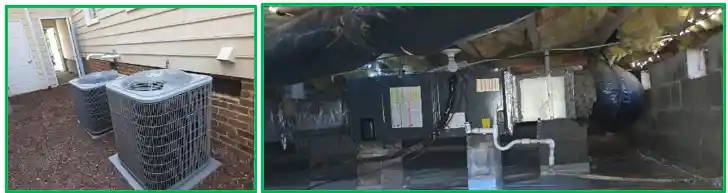
Prior to the 1973 era, most homes relied on natural ventilation and lacked mechanical central air conditioning. When central air was introduced, it fundamentally changed the indoor climate of North Carolina homes by artificially chilling the living space—typically down to a comfortable 73 degrees.
Almost overnight, building dynamics shifted. The introduction of cold air inside the home meant that new building codes had to emerge rapidly to deal with an invisible consequence: condensation in the home AND on the crawlspace chilled ceiling.
When the warm, moist outside air of North Carolina comes into contact with artificially cooled surfaces, it sweats. And one of the primary areas where this physics problem wreaks havoc is right beneath your feet.
The Mechanics of Moisture: How Crawlspace Ceilings Sweat
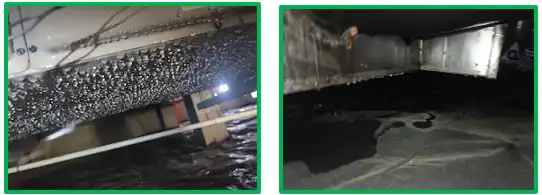
In a traditional vented crawlspace, the ceiling of the crawlspace (the underside of your subfloor and floor joists) is effectively chilled by the air-conditioned home above it, sitting right around that 73-degree mark.
Meanwhile, outside air flows freely through the foundation vents. Because North Carolina summers bring heavy heat and humidity, that warm, moisture-laden outside air enters the crawlspace. Driven by a natural phenomenon known as the stack effect, this warm air wants to rise up into the living spaces of the home.
As the air travels upward, it hits the cold 73-degree ceiling of the crawlspace. Just like a cold glass of sweet tea sitting on a humid porch table, that subfloor and those floor joists sweat.
The 16% Rule: Wood Moisture Content, Mold, and Structural Decay Once conden
Once condensation forms on the wood, gravity pulls the moisture down to the lowest point: the bottom of the floor joists. This is precisely where professionals measure wood moisture content (WMC).
Below 20%: Wood is generally safe from active decay.
Over 16% Wood Moisture Content: This is the critical threshold. Any wood moisture content exceeding 16% gives mold the green light to grow.
Once mold takes root on those joists, it starts to feed and decay the wood. Over time, the structural integrity degrades:
Floor joists lose their strength.
Floors begin to feel soft, spongy, or bouncy underfoot.
Hardwood floors inside the home start to cup and warp as they absorb subfloor moisture.
The Indoor Air Quality Connection: The Stack Effect and Your Health
Beyond structural damage, the air in the crawlspace doesn’t stay in the crawlspace.
Because of the stack effect, that warm, rising mass of air continuously pulls upward through the flooring penetrations, wall cavities, and living spaces. In fact, studies show that roughly 50% of the air breathed inside a home originates directly from the crawlspace.
If that crawlspace is damp, moldy, and neglected, the residents aren’t just walking on compromised floors—they are breathing in mold spores, musty odors, and unhealthy air every single day.
What This Means for Real Estate Transactions
For real agents, spotting or anticipating crawlspace issues can save a transaction from falling apart during the due diligence period. Whether representing a buyer or a seller, identifying high wood moisture, framing deflection, or active mold early allows for proactive remediation—such as proper sealing and encapsulation—protecting both home values and buyer health.